
Custom AI for growing businesses
Tell us what's slowing your business down. We'll build the AI that handles it.
Cloudfinch finds the work worth automating, builds AI agents and software around how you operate, and keeps them running after launch. First system in production in about four weeks, at a fixed fee.
- RoutedAnomaly · /pricing traffic·Down 23% vs. 7-day baseline
Alert sent to growth channel
- Auto-handledAppointment · Job 4435·Running 12 min late · prior job overran
Client notified · day re-planned
- RoutedLead · enterprise tier·Routed by ICP score · 87/100
Assigned to AE Marcus
- Needs reviewInvoice #4827·Vendor mismatch · price off 8%
Held for AP review
- Needs reviewContract · vendor MSA·Renewal in 30 days · price clause changed
Summary sent to Priya for review
Illustrative · agents handle the routine, escalate the rest.




Some of the things we build
Every business runs a little differently, so no two systems we build are the same. These are the ones that come up most often.
Scheduling and operations systems
Scheduling, exception handling, and a live view of the work. Agents make the routine calls a coordinator would and escalate the rest.
Client portals with AI intake and routing
Clients upload documents and your team gets a summary. Each document is classified on arrival and the next step is suggested, so nothing sits in an inbox.
Internal ops dashboards with predictive signals
Live business metrics that flag unusual numbers as they happen. Reports are drafted automatically.
Custom CRMs and pipelines
Built around how your team sells. AI summarizes calls, classifies leads, drafts follow-ups, and updates records, so nobody re-types notes.
Inventory, supply chain, and fulfillment tools
Demand forecasting, reorder points, and exception routing. Agents handle routine reorders and pass the exceptions to your team.
Recommendation and merchandising engines
Models trained on your catalog and customer behavior, data no competitor has. They improve as the data grows.
Don't see your business here? Tell us what you're running and we'll tell you whether we can help.
The expertise to build it, without building a team for it
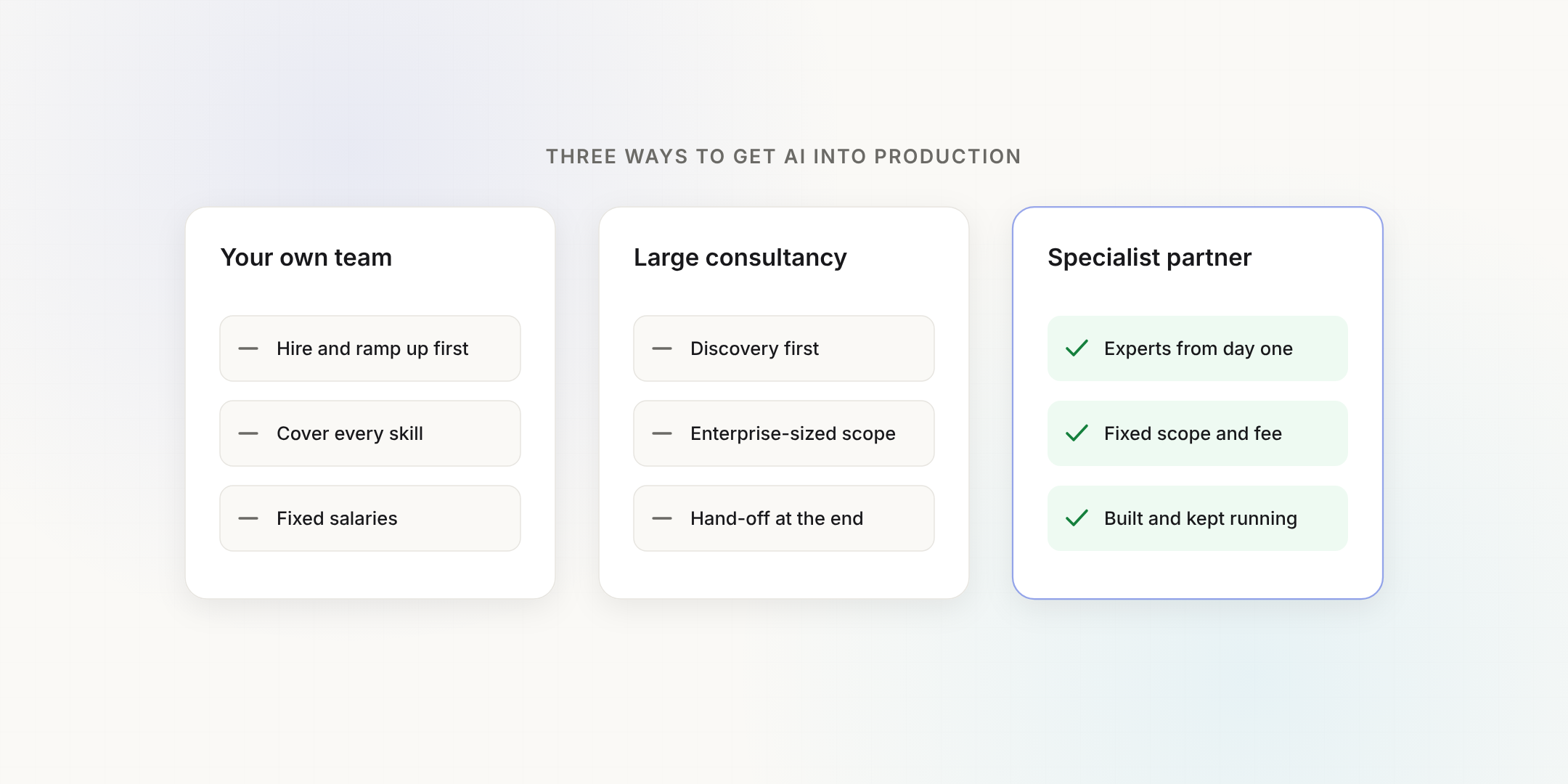
Getting AI to do real work takes people who have built and run these systems before. Most growing businesses end up choosing between three ways of getting them.
Build your own team
- A hiring and ramp-up period before anything ships.
- Several skills to cover: software, data, AI evaluation, and operations.
- Senior salaries, whether or not there is a project that month.
- When people leave, the knowledge often leaves with them.
Bring in a large consultancy
- Discovery phases and strategy work before anything is built.
- Engagements sized and priced for enterprise budgets.
- A hand-off at the end, and someone else to run what was built.
Work with Cloudfinch
- Specialists who have shipped custom software since 2012 and run AI systems in production today.
- A fixed fee per engagement, agreed before work starts.
- A first system in production in about four weeks.
- The people who scope it build it and run it after launch.
- Documentation, evals, and runbooks in your repository, so you’re never locked in.
What the AI does once it's running
This is what we mean when we say a system is AI-native. Ask us on the call and we'll show you any of it working on real data.
It handles the routine work
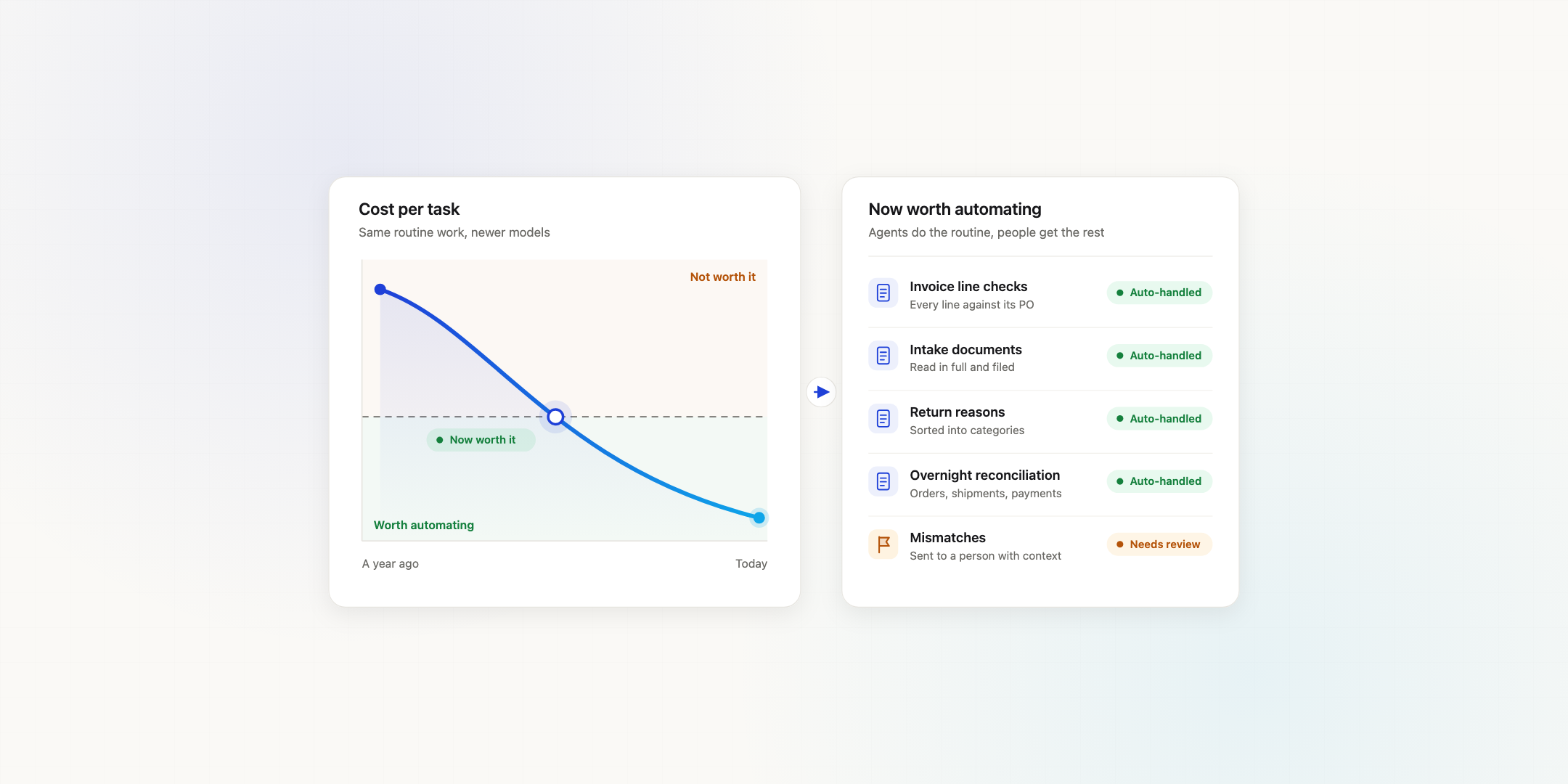
The software does the work itself. A scheduling agent re-plans the day when a job runs late. An intake agent processes new client paperwork from start to finish. A reconciliation agent matches invoices and escalates the ones that don't match. You set the rules, and the agents ask for help when they're unsure.
You can ask it questions in plain English
Requests go straight to your data and your agents. Ask "show me which clients haven't paid this month and have the follow-up agent draft replies in my voice" and the drafts come back ready to send.
It makes the routine calls along the way
Classification, routing, prediction, and anomaly detection run as steps in the workflow. When an invoice arrives, it's classified, sent to the right approver, and flagged if it doesn't match the usual pattern.
It keeps up, and gets better at your business
Models get deprecated, APIs change, and the tools your agents depend on get updated. We run evals, upgrade models, and migrate agents so they keep working. We also feed your team's decisions and corrections back in, so the agents handle more of your edge cases each month.
How a project runs
It starts with a free 30-minute call. From there, every stage ends with software you can use, so you see progress as you go.
Intro call
We spend 30 minutes, free, learning how your business runs and where things get stuck.
First system
We pick the work worth automating first, build the system, and get it running on your real data. The fee is fixed and agreed up front.
Get started in as little as 2 weeks.
Build
If there’s more to do, we keep going in stages. Each one ends with working software, and if you stop at any point, you keep what’s been built.
Operate
Once it’s live, we keep it running. We update it as AI models and tools change, catch anything that starts slipping, teach it your edge cases, and add to it as the business grows.
We've been building software since 2012
Here's a little of what that looks like, and what two of our clients had to say.
Building custom software since
From kickoff to first working module in production
From the first call to running it in production
Per engagement, never hourly
“The custom scheduling system Cloudfinch built replaced three separate tools and cut our operational workload by 40%.”
“Cloudfinch delivered our logistics platform’s MVP in just four weeks. We went from manual Excel tracking to automated route optimization — saving 15 hours a week.”
With a 30-minute call about your business, where the hours go, and which piece of work AI should take on first. If we’re a fit, we send a fixed-fee proposal within a week.
No. We use the call to work out whether there’s a system worth building and whether we’re the right team to build it. If the timing is wrong, or the work is outside what we do well, we’ll tell you.
No. Most of the businesses we work with have no engineers in-house. We handle the design, the build, the hosting, and the ongoing care. Your team uses the system and tells us what to change.
Sometimes, and often in part. Where a SaaS tool fits, we integrate with it; where it doesn’t, we replace it. Most engagements do some of each, and the intro call is where we work out which.
You don’t need to be. Most engagements start with the one workflow causing the most trouble. You run that on software built for you, see how it goes, and decide what comes next.
You own the code. The system ships with its documentation, its eval suite, and runbooks in your own repository, so any capable engineer can pick it up. Most clients stay on Operate because the agents need ongoing care, but you’re free to take the system elsewhere.
Your business data stays in systems you control. We use API-tier models from OpenAI, Anthropic, and Azure OpenAI that don’t train on customer inputs. For sensitive workloads we run smaller open models inside your own cloud tenant (AWS, GCP, or Azure). The data-handling boundary is agreed in writing before any data leaves your environment, and we sign NDAs and DPAs as standard.
We design for a predictable monthly run cost: we cache repeated calls, keep prompts lean, and route the easy 80% of traffic to cheaper models. The proposal includes a projected monthly bill. If a provider deprecates a model or changes its pricing, switching models is part of Operate, so you aren’t tied to one vendor.
Latest from the blog
Notes from putting AI to work in growing businesses.

Start with the work that slows you down the most
In 30 minutes we'll go through where the hours go and tell you which piece of work AI should take on first.